 Written by JC Team
Grand sumo tournaments happen in just four cities — Tokyo, Osaka, Nagoya, and Fukuoka — and tickets disappear fast enough that for many travelers the schedule simply doesn’t line up. The sumo calendar has a second half, though: the jungyō (provincial tours), which send the sport’s top wrestlers to city gymnasiums all over Japan between tournaments.
A jungyō stop squeezes a whole sumo festival into one day: open morning practice, comic sumo, sumo folk songs, the ring-entering ceremonies, and an afternoon of top-division bouts, in venues small and local enough that you’re never far from the action.
The winter 2026 tour starts on November 29, working through Kyūshū and Kansai before a two-day finale in Okinawa.
What exactly is a jungyō?
Four times a year, between the six grand tournaments, the Japan Sumo Association takes its touring roster on the road. Each stop is a one-day exhibition hosted by a local organizing committee, usually in the city gymnasium, and the mood is nothing like a tournament: no rankings at stake, plenty of clowning, and wrestlers with time to pose for photos and sign autographs, especially in the morning.
With dozens of stops a year spread from Okinawa to Aomori, there’s a fair chance a jungyō passes near wherever your Japan trip takes you.
The 2026 jungyō schedule
There are four tours a year: spring (late March to April, opening with a dedication performance at Ise Grand Shrine), summer (August — in 2026 it leaned heavily into Tōhoku), autumn (October), and winter (late November to December).
The official schedule is published in English, with each stop linking to a local organizer page — those are almost always Japanese only.
Here’s the 2026 winter schedule, followed by the autumn tour, which has now finished.
Winter tour: November 29–December 20
| Dates | Area | Stops |
|---|---|---|
| Nov. 29–Dec. 6 | Kyūshū, plus Kure | Amakusa and Kumamoto (Kumamoto), Nobeoka (Miyazaki), Aira (Kagoshima), Nagasaki, Iizuka (Fukuoka), Kure (Hiroshima) |
| Dec. 7–12 | Kansai | Miki, Nishinomiya, and Sanda (Hyōgo), Katano and Yao (Osaka), Uji (Kyoto) |
| Dec. 13–16 | Shizuoka and Kantō | Shizuoka, Fuji, Hiratsuka (Kanagawa), Hasuda (Saitama) |
| Dec. 19–20 | Okinawa | Uruma — the only two-day stop of the year |
Autumn tour: October 6–25 (completed)
| Dates | Area | Stops |
|---|---|---|
| Oct. 6–9 | Kantō | Tsukuba (Ibaraki), Ebina (Kanagawa), Sayama and Chichibu (Saitama) |
| Oct. 10–13 | Nagano and Hokuriku | Matsumoto, Imizu (Toyama), Kanazawa and Kahoku (Ishikawa) |
| Oct. 14–15 | Gifu and Shiga | Takayama, Nagahama |
| Oct. 16–20 | Kansai | Kyoto, Osaka, Himeji, Akashi |
| Oct. 21–25 | Chūgoku | Okayama, Wake, and Kasaoka (Okayama), Hiroshima, Ube (Yamaguchi) |
The spring 2027 tour hasn’t been announced yet; going by recent years, expect it from late March, with dates published a few months ahead on the same schedule page.
What a day at a jungyō looks like
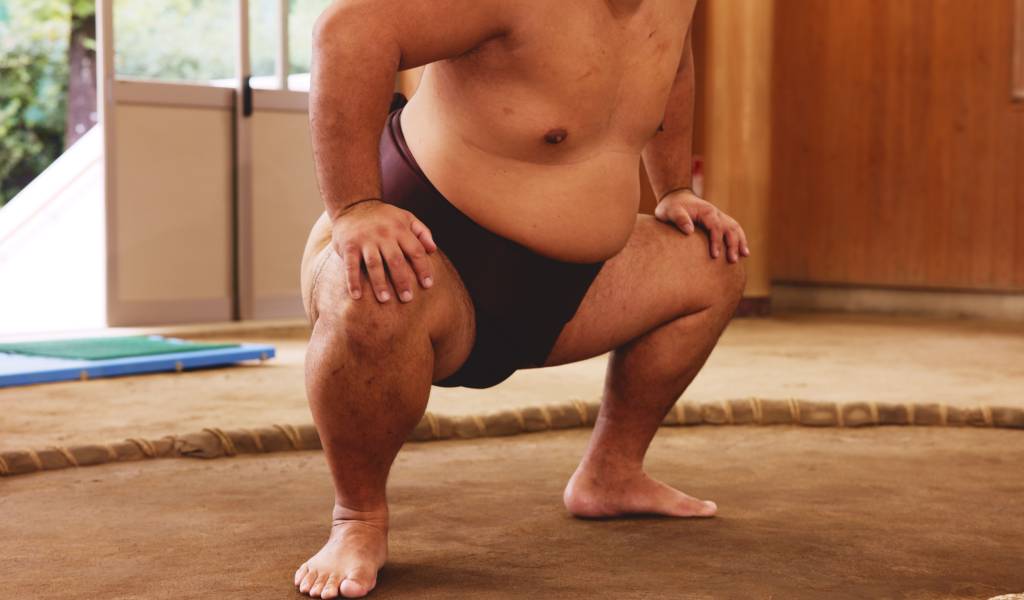
Doors open around 9 a.m., and the morning is all practice: lower divisions first, then the top division, training at close range while the hall slowly fills. For many fans this is the best part — you can watch from arena level as the stars warm up, and this is prime time for autographs and photos.
Around noon the bouts begin, starting with the lower divisions and interleaved with sideshows you won’t see at a tournament: shokkiri (comic sumo, which explains real techniques and fouls by cheerfully breaking every rule), jinku (sumo folk songs, performed by the wrestlers themselves), taiko drumming demonstrations, and often local extras like topknot-dressing demonstrations.
At about 1 p.m. come the ring-entering ceremonies, then the top-division bouts, with the day closing on the bow-twirling ceremony between 2:30 p.m. and 3 p.m.
Every stop sets its own timetable, so check the organizer’s page: most run roughly 9 a.m.–3 p.m., but the first day in Okinawa doesn’t open until noon and runs until 5:30 p.m.
Stops worth planning around
If you’re traveling in Japan during the winter tour, a couple of stops are particularly easy to fold into a trip.
Nagasaki (December 3): At Happiness Arena, part of the Nagasaki Stadium City complex. Arena-level seats have sold out, but second-floor seats were still available in late October, with sales running until December 2.
Uruma, Okinawa (December 19–20): The tour finale and the only two-day stop, at the Ishikawa Multi-purpose Dome. Day one is an afternoon event (doors at noon), while day two runs the full program from 9 a.m. Standing tickets are ¥5,000, and the two-person pair seats have already sold out.
And if you’re Tokyo-based, the two December stops in Hiratsuka and Hasuda (December 15–16) are day-trippable from the capital — our sister site’s guide to catching a jungyō near Tokyo covers those in detail.
Tickets and prices
Every stop is run by a different organizer, and ticketing is gloriously local. Most sell through Japan’s big ticketing platforms — Ticket Pia (which has an English site), Lawson Ticket, and e+ — plus convenience-store ticket machines, and some add city-hall counters, newspaper sales offices, or phone desks that are cash only and Japanese only.
Many stops also route through the central jungyō ticket office (0570-05-3366, 10 a.m.–5 p.m., Japanese only). The organizer links on the official schedule page are the place to start.
Prices vary a lot by stop and seat type. As a rough guide from the 2026 tours: the cheapest upstairs seats ran from ¥3,000 in Osaka to ¥6,000–¥10,000 at the Kantō stops, arena-level chairs roughly ¥11,000–¥15,000, and ringside cushions and box seats ¥15,000 and up. Advance-only bento and souvenir sets (around ¥2,500–¥5,500) are a staple.
Sales typically open four to five months ahead, and popular dates don’t wait: Hiroshima’s October 24 stop sold out well in advance, and Chichibu was down to its last seats a week before the event. If a date fits your itinerary, buy when sales open.
Before you go
- Many venues are no-shoes zones, at least on the arena floor — pack slippers or decent socks.
- Local ticket counters and phone desks usually deal in cash.
- Child policies vary by stop and seat type: arena-floor seats generally require a ticket at any age, while small children can often sit on laps free in the stands. Age cutoffs differ, so check the organizer’s page.
- Outside food and drink are often banned — alcohol almost always.
- The wrestler line-up is never guaranteed, as injured wrestlers skip tour dates. Go for the spectacle rather than one star.
- Details change: confirm dates and times on the Japan Sumo Association’s English schedule and the stop’s own organizer page before traveling.
For the main event, see our sister site’s guide to seeing sumo in Tokyo. And for what else is on while you’re here, check our roundups of November and December events across Japan.
While we do our best to ensure it’s correct, information is subject to change.