 Written by JC Team
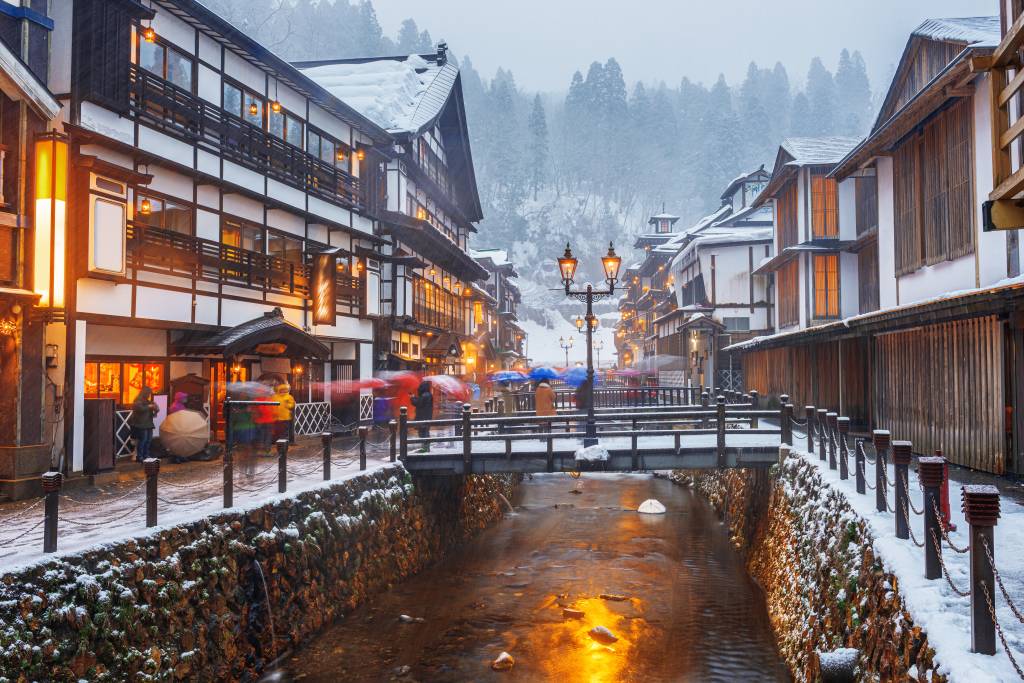
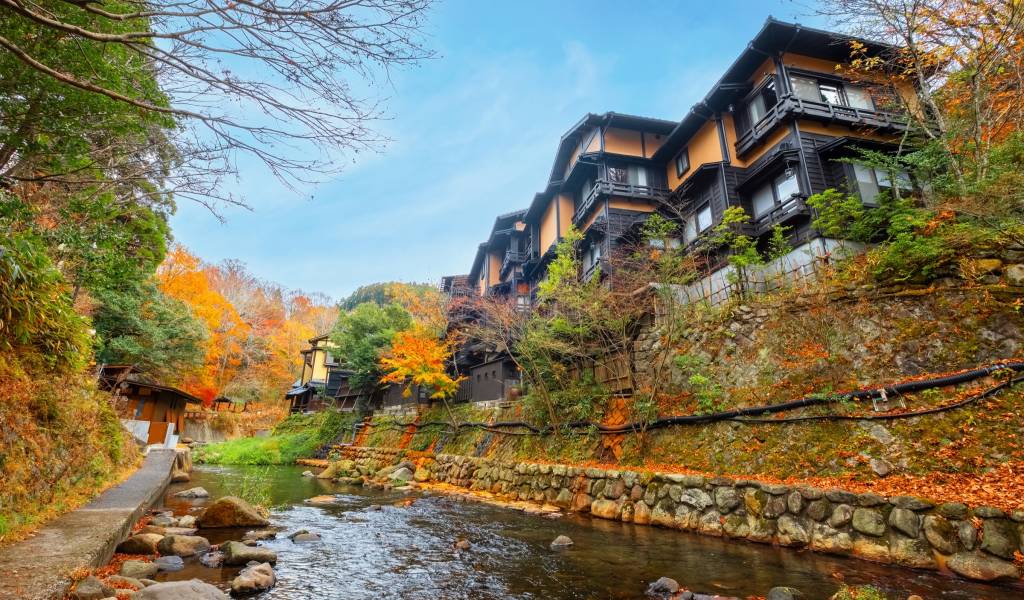
Kurokawa Onsen is a small hot-spring town in the hills of northern Kumamoto, about 700 m above sea level and a long way from any train station. Around 30 ryokan (traditional inns) line a narrow river valley, and most of them open their outdoor baths to day visitors.
The local trick is to treat the whole valley as one big inn and wander from bath to bath on a single wooden pass. Getting there takes a little planning, since only a few buses a day run in. Here’s what the pass costs, how the buses work, and whether you should stay the night.
Pro tip: For more of the region, see our guide to Kyūshū.
The bath-hopping pass
The nyūtō tegata (bath-hopping pass) is a round wooden token cut from local cedar or cypress, and it’s the reason most people go to Kurokawa Onsen. One pass gets you into any three of the 25 rotenburo (outdoor baths) at participating ryokan. At each one, the front desk stamps your pass with the inn’s own seal and you peel off one of the three stickers on the back.
You can also swap one bath for food or a souvenir. Use the two red stickers for baths and the green one at a participating shop or café. The list changes, but it has included honey soft-serve, doughnuts, and locally made miso.
The pass started in 1986 as a way to help two inns that couldn’t build outdoor baths of their own. The idea was to lift the whole town, not just individual inns. One percent of sales now goes to landscape and hot-spring conservation.
| Nyūtō tegata bath pass | Details |
|---|---|
| Adult pass | ¥1,500 |
| Child pass (age 3 to end of elementary school) | ¥700 |
| What you get | 3 baths, or 2 baths plus 1 food/souvenir item |
| Participating baths | 25 outdoor baths |
| Valid for | 6 months from purchase |
| Bathing hours | 8:30 a.m.–9 p.m. (varies by ryokan) |
| Where to buy | Kazenoya information center or any participating ryokan |
| Sharing | One pass per person, no sharing |
Is the pass worth it?
Usually, yes. Paying at the door costs ¥500 to ¥800 per bath depending on the ryokan, so three baths bought one by one come to somewhere between ¥1,500 and ¥2,400. The pass costs ¥1,500 flat.
If you only want one or two baths, skip the pass and just pay at the door.
The 40th-anniversary pass
Passes sold from July 1, 2026, to the end of March 2027 carry a special 40th-anniversary design. The little bathing man who has always sat in a bath on the front has climbed out, and you complete the design by collecting his stamp where passes are sold. Two rarer stamps are hidden around town. The association is printing 50,000 of these, and sales stop when they run out.
Day-bathing hours and closures
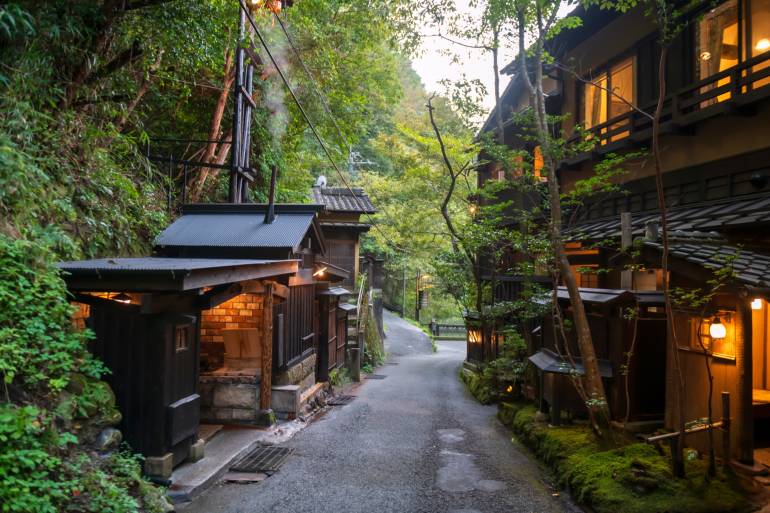
The general window for day bathing is 8:30 a.m.–9 p.m., with last entry at 8:30 p.m. Each ryokan sets its own hours inside that, though. On the (random) day we checked, some inns let day visitors in from 8:30 a.m., one only from 10 a.m. to 2:30 p.m., and several only in the afternoon. Some were closed to day visitors altogether. So do check before you go!
The ryokan association posts each inn’s day-bathing hours and current crowd levels online. It’s updated daily, so check it around 9 a.m. on the day you go.
Baths can also close at short notice. Some shut for an hour or so in the morning for cleaning, and busy baths may stop taking day visitors (groups are asked to split up). If rain or snow cools the water too much, ryokan may stop day bathing without warning.
Many shops and inns also close on irregular days, and Tuesday to Thursday is when you’re most likely to find places shut.
Etiquette and tattoos
Bathing in Kurokawa follows standard onsen rules. If it’s your first time, read our guide to how to onsen in Japan before you go, and our ryokan etiquette guide if you’re staying over.
A few local rules to know: photography is banned in the baths and changing rooms. There’s no mixed bathing in the outdoor baths anymore. The association says it stopped after a change to Kumamoto Prefecture’s rules, and suggests couples use a private bath instead.
And don’t bring food or drinks into the baths!
Tattoo policies
There’s no town-wide rule. Each ryokan sets its own policy, and the association asks visitors with tattoos to contact it through its inquiry form before visiting.
Some ryokan offer daytime private baths, which are another option. Most can’t be booked in advance, but you can call the ryokan ahead to ask if one is free. From 3 p.m., overnight guests get priority. See our guide to ryokan with private onsen for ideas elsewhere in Japan.
Getting to Kurokawa Onsen
There’s no train. Kurokawa is reached by highway bus from Fukuoka, Kumamoto, Aso, Yufuin, and Beppu, or by car. All the buses below need a reservation, made no later than the day before you travel.
| From | Bus | Time | One-way fare |
|---|---|---|---|
| Fukuoka (Tenjin) | Fukuoka–Kurokawa Onsen highway bus | 3 hours | ¥4,000 |
| Fukuoka (Hakata Bus Terminal) | Fukuoka–Kurokawa Onsen highway bus | 2 hours 35 minutes | ¥4,000 |
| Fukuoka Airport (international terminal) | Fukuoka–Kurokawa Onsen highway bus | 2 hours 15 minutes | ¥4,000 |
| Kumamoto Station | Kyūshū Ōdan Bus | 2 hours 50 minutes | ¥3,400 |
| Kumamoto Airport | Kyūshū Ōdan Bus | 1 hour 55 minutes | ¥2,600 |
| Aso Station | Kyūshū Ōdan Bus | 50 minutes | ¥1,600 |
| Yufuin Station bus center | Kyūshū Ōdan Bus | 1 hour 35 minutes | ¥2,700 |
| Beppu Station | Kyūshū Ōdan Bus (one morning bus only) | 2 hours 35 minutes | ¥4,000 |
From Fukuoka
The Fukuoka–Kurokawa Onsen highway bus is run by Kyūshū Sankō Bus and Hita Bus. Three buses a day leave Nishitetsu Tenjin Highway Bus Terminal at 9:30 a.m., 11:15 a.m., and 12:40 p.m., stopping at Hakata Bus Terminal and Fukuoka Airport on the way.
Return buses leave Kurokawa at 10 a.m., 11 a.m., and 2 p.m.
Seats go on sale one month ahead, and you need to book buses leaving Kurokawa by 7 p.m. the day before. Book online through Highway Bus.com or by phone (details on Kyūshū Sankō’s timetable page). For more on the city itself, see our ultimate guide to Fukuoka.
From Kumamoto, Aso, Yufuin, and Beppu
The Kyūshū Ōdan Bus (literally the “Kyūshū cross-island bus”) runs between Kumamoto and Beppu, stopping at Kumamoto Airport, Aso Station, Kurokawa Onsen, and Yufuin. Buses leave Kumamoto Station at 7:23 a.m., 8:23 a.m., and 12:08 p.m.
Heading the other way, buses leave Kurokawa for Kumamoto at 10:45 a.m., 3:25 p.m., and 4:25 p.m. Toward Yufuin they leave Kurokawa at 10:15 a.m., 11:15 a.m., and 3 p.m. Only one of those runs all the way to Beppu. You can book from two months before until the day before, online through Hassha Orai Net or by phone (timetable).
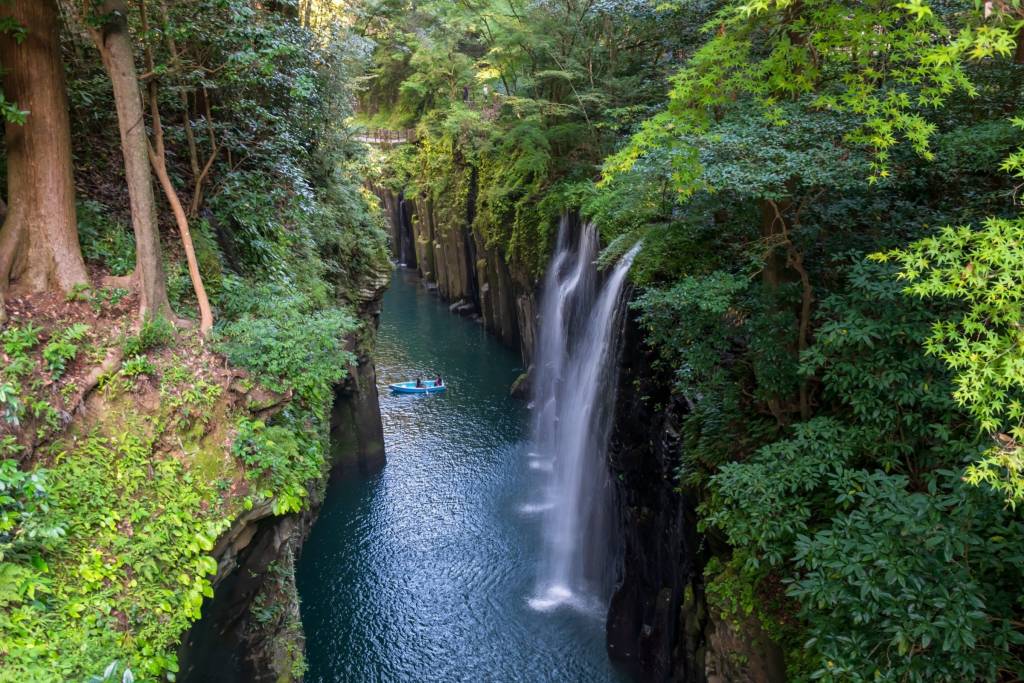
If you’re coming from Kumamoto, Kumamoto Castle fits nicely into the day before or after. From Aso Station, the Asochiho-gō bus runs one round trip a day on to Takachiho Gorge, if you want to pair the two. From the Ōita side, our guide to getting from Ōita Airport to Beppu and Yufuin covers the first leg, and Beppu’s Eight Hells make a good stop on the same trip.
Pro tip: the SUNQ Pass, a multi-day bus pass covering most of Kyūshū, is valid on both of these routes. You still need to reserve a seat. Worth pricing up if you’re riding several long-distance buses in a few days.
Note: Kumamoto’s tap-to-pay half-fare campaign, running from October 29, 2026, does not include the Kyūshū Ōdan Bus, so the fares above are what you’ll pay. It does cover the Hinokuni-gō bus between Fukuoka and Kumamoto, if you’re coming that way.
By car
Aso, Yufuin, and Hita are each about 1 hour away by car. Public parking in town is free (except for one paid lot), and the largest is Kurokawa Parking on Route 442. Most ryokan car parks are only for overnight guests. Our Kurokawa Onsen Town listing has the location on a map.
From December to March, expect snow and ice on the mountain roads: the association says you’ll need winter tires or chains.
Day trip or overnight?
It depends where you’re coming from.
From Kumamoto or Yufuin: a day trip works
The 7:23 a.m. bus from Kumamoto Station gets in at 10:15 a.m., and the 3:25 p.m. or 4:25 p.m. bus gets you back to Kumamoto Station at 6:03 p.m. or 7:03 p.m. That gives you five or six hours.
From Yufuin, the 9:10 a.m. bus arrives at 10:45 a.m., and the 3 p.m. bus back gets in at 4:33 p.m. The association reckons three baths take about 2–3 hours, so either works.
From Fukuoka: go one way
A return day trip from Fukuoka by bus is tight. The earliest bus arrives at 12:29 p.m. and the last bus back leaves at 2 p.m., which leaves you about an hour and a half.
A better plan is to take the morning bus from Fukuoka, then continue on the Kyūshū Ōdan Bus to Kumamoto (3:25 p.m.) or Yufuin (3 p.m.) and spend the night there. Fukuoka to Kurokawa to Kumamoto comes to ¥7,400 in bus fares.
If you’d rather not juggle timetables, some tour companies run day trips from Fukuoka that pair Aso’s Kusasenri grasslands with a few hours in Kurokawa.
Staying overnight
A night here means you can bathe in the evening and early morning, once the day-trippers have gone. Ryokan stays aren’t cheap, so look at plans that drop the ryokan dinner: the association’s booking site has a filter for one-night stays with breakfast only.
For stays from October 1 to December 25, 2026, the Kumamoto Fukkō Ōen-wari (Kumamoto recovery support discount) takes 60% off accommodation in Kumamoto Prefecture. It’s Kumamoto’s share of a government-funded discount for Kyūshū, capped at ¥20,000 per person per stay for an accommodation-only booking. Accommodation and bathing taxes aren’t discounted.
Visitors from overseas qualify, but business trips don’t, and you’ll sign a form at check-in to confirm. Book through a participating ryokan, travel agency, or booking site. Bookings made on the association’s own site don’t qualify. Discounted rooms have been selling out fast, and the scheme ends early if the budget runs out.
The official discount site (in Japanese) lists participating sellers. Check with your booking site that the discount still applies before you book.
Or stay somewhere cheaper and come in for the day. Aso Station is 50 minutes away on the Kyūshū Ōdan Bus, and Kumamoto works as a base too.
When to go
Kurokawa is around 3–5°C cooler than the lowlands, which makes summer nights pleasant and winter properly cold. Autumn leaves are usually at their best from late October to mid-November, and the cherry blossoms come out around early April, both a little later than in the cities below. Autumn is also one of the busiest times to book a room, so reserve early if you want to stay.
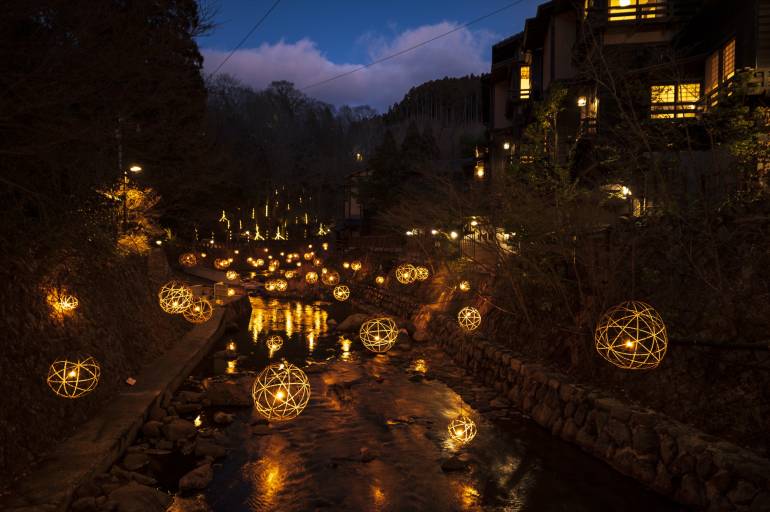
In winter the town runs Yuakari, an evening lantern display of round lights made from bamboo, usually from late December to the end of March. Dates are announced on the association’s website. It looks its best with a bit of snow around, but snow also means icy roads, and baths sometimes stop taking day visitors when the water cools.
Practical tips
Bring cash. As far as we know, there is still no ATM in Kurokawa (the nearest is about 15 minutes away by car), and many shops and inns take cash only.
Bring a towel, too. There’s no towel rental, though you can buy one at the information center, local shops, or ryokan for about ¥300 to ¥500.
Buy your pass at Kazenoya, the association’s information center by Fureai Hiroba Parking, if you can. It’s open 9 a.m.–5 p.m. and is the surest place to get one, since individual ryokan sometimes run out.
Most ryokan are within walking distance of each other, but a few are 30 minutes or more on foot from the center and taxis are scarce. If you’re short on time, pick baths close together. For a breather between baths, Betchinkan, below Kazenoya, is a free rest area open 10 a.m.–4 p.m.
Sources: Kurokawa Onsen ryokan association (pass), association FAQ, 40th-anniversary press release, Kyūshū Sankō Bus (Fukuoka route), Kyūshū Sankō Bus (Kyūshū Ōdan Bus), Kumamoto Prefecture (recovery discount). Information is subject to change, so check before you travel.